
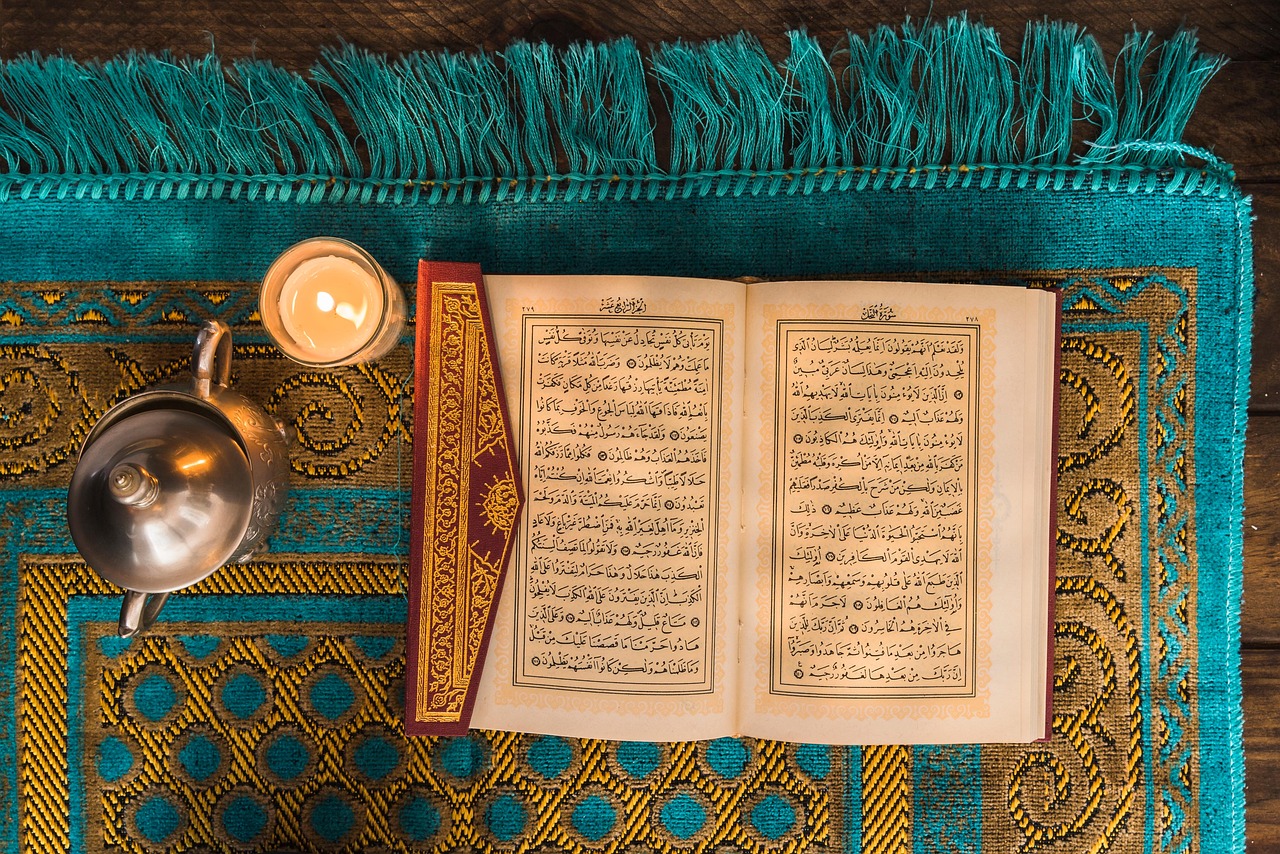
The different ‘versions’ of the Quran refer to the seven different ‘ahruf’ in which the Quran exists today. ‘Ahruf’ is an Arabic word and is actually the plural form of ‘harf,’ which means ‘a letter.’ And ‘Ahruf’ can mean ‘the letters that form a word.’ But when taken in the context of the Quranic revelation, according to Sheikh Asim, this word can refer to an accent, a different structure of the word with meanings that don’t contradict one another but rather flow in the same channel, giving the word itself additional meaning.
The Prophet PBUH said Jabreel AS taught him to recite the Quran in one style. However, the Prophet PBUH kept asking him for more until Jibreel AS gave him seven styles. Ibn Shibab said, ‘These seven styles are essentially one. They don’t differ about what is forbidden and what is not.
Difference in Recitation, Not In Meaning
The Quran was revealed in seven ways. This means that some words may differ, but they have the same meaning. Or, some words may differ, having an alternative meaning that adds more value to the verse. These seven different styles don’t mean that the meaning of the verse changes in each mode of recitation; rather, it means that some of the words are different, but the meaning remains the same.
For example, if a person says, ‘I am going to get there in about 2 hours.’ Or if they say, ‘I am going to arrive in about 2 hours.’ The meaning of the sentence remains the same, but only the wording changes.
Umar RA narrated that he heard Hisham bin Hakim reciting Surah Al-Furqan during the lifetime of Prophet PBUH, and Hisham recited it in several different ways that Prophet PBUH hadn’t taught Umar RA. Later on, when Hisham completed his prayer, Umar RA seized him by his neck and questioned him, ‘Who taught you this surah which you were reciting?’ He said, ‘Prophet PBUH.’ To which Umar RA replied, ‘You are lying because the Prophet PBUH taught it to me in a different way.’
So Umar RA dragged Hisham to the Prophet PBUH and explained that difference in recitation. Hearing this, the Prophet PBUH told Hisham to recite, and he recited. After this, he told Umar RA to recite, and he recited. Then Prophet PBUH said, “It was revealed like this. It has been revealed to be recited in seven different ways, so recite it in the way that is easier for you.”
Why The Different Ways?
The Prophet PBUH met with Jibreel AS and said to him, ‘O Jibreel, I have been sent to a nation that is illiterate. Among it are old women, old men, the boy and girl, and the man who can’t read a book at all.’ Jibreel AS replied, ‘Indeed the Quran was revealed in seven modes.’
Ibn Qutaybah, an early Muslim scholar, said:
“For the Muslims to read the Quran easily, it was commanded to the Prophet PBUH to teach the Quran in accordance with the dialects of the people. Because if everyone were to abandon their dialect and abandon what they were used to speaking as a child, as a youth, and in their old age, this would be a great difficulty and hardship for them. Therefore, Allah SWT intended ease for the people by allowing them some flexibility.”
Style of the Quran & The Later Generations
When the Quran was compiled into a book during the Caliphate of Umar RA, he did so in one style. He omitted the vowel points and dots so that some other styles could also be accommodated. Therefore, the Mushaf (the written copy of the Quran) in the time of Umar RA could be read in other styles.
As a result, whatever styles the mushaf accommodated remained in use, whereas those it didn’t accommodate didn’t. This also proved to be a way to unite people, since they had started criticizing one another for differences in recitation.
Anas bin Malik narrated that Hudhaifa bin Al-Yaman came to Usman RA at the time when the people of Iraq and Sham were waging war to conquer Adharbijan and Arminya. Hudhaifa was afraid of their differences in the Quranic recitation so he said to Usman RA, ‘Save this nation before they differ about the Quran as the Jews and Christians did.’ Therefore, Usman RA sent a message to his daughter, Hafsa RA, which said, ‘Send us the manuscripts of the Quran so that we may compile the materials in perfect copies and return to you.’ Hafsa RA sent it to her father, and he ordered Zaid bin Thabit, Abdullah bin Az-Zubair, Said bin Al-As, and Abdur Rahman bin Harith bin Hisham to rewrite the manuscripts in copies.
Then Usman RA said to three Quraishi men, “In case you don’t agree with Zaid bin Thabit on any point in the Quran, then write it in the Quraishi’s dialect; the revelation of the Quran was in their tongue.’ They did that, and when many copies had been written, Usman RA returned the original manuscripts to Hafsa RA. Usman RA sent every Muslim copy of the Quran they had compiled and ordered all the other Qur’anic materials, whether they were written as whole copies or fragmentary manuscripts, to be burned.