
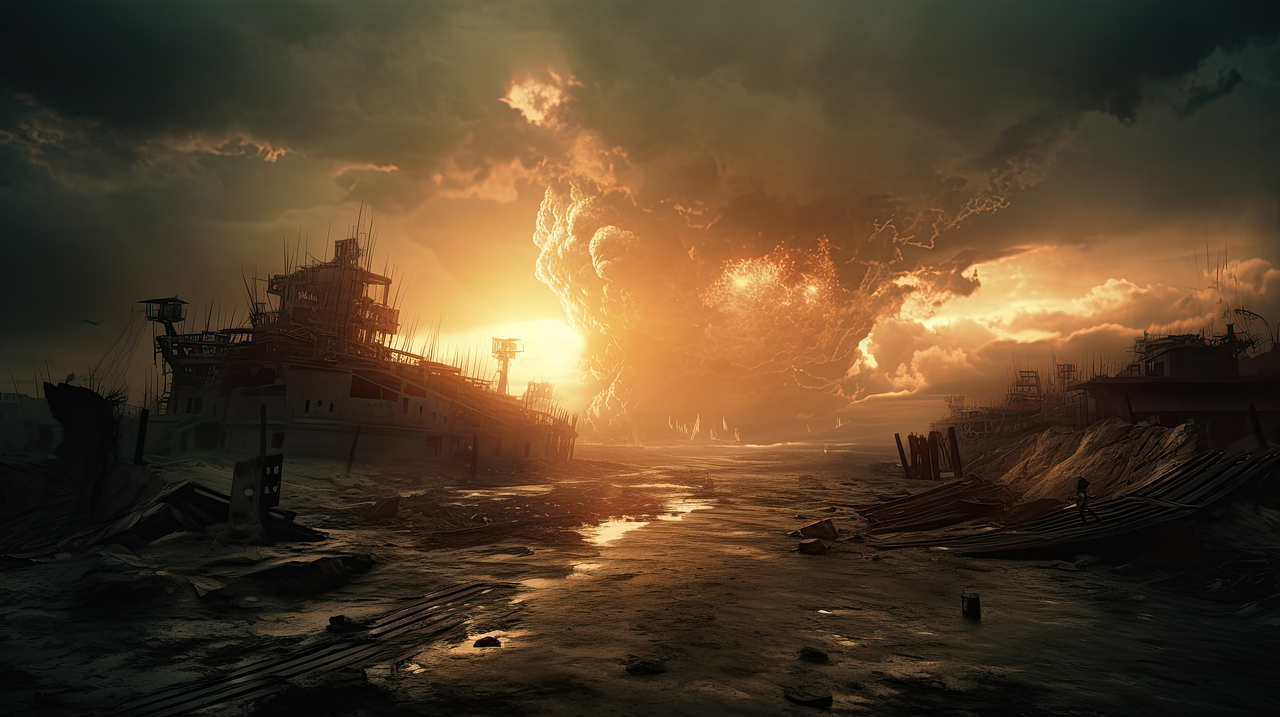
Allah! There is no God save Him. He gathereth you all unto a Day of Resurrection, whereof there is no doubt. Who is more true in statement than Allah?
The day of Qayamah, the ultimate judgement. The day when every human will be held accountable for each deed they committed in their earthly life. The concept of ‘Qayamah’ in Islam is one that is strong enough to shake one’s soul. It is the time when the doors of Allah’s mercy will close, and the world will cease to exist. This day marks the beginning of the afterlife.
Qayamah: The Resurrection, Judgement & Eternal Life
Do such (men) not consider that they will be raised again unto an awful Day, The day when (all) mankind stands before the Lord of the Worlds?
[Surah Al-Mutaiffifin, Verse 4-6]
Qayamah is a significant belief for Muslims and one of the six articles of faith in Islam. It is so necessary that one’s faith is not complete if they don’t believe in the day of judgement. According to Islam, the Qayamah is when time won’t exist anymore, and the hereafter will commence for eternity. However, the time of Qayamah also co-exists with the time of resurrection, and the two terms are often used interchangeably. This is because mankind will first be resurrected and then judged according to their deeds. Between the resurrection and the judgement, a few other events will take place. This blog will discuss these events in detail and explore what the Quran and Sunnah state about them.
The Gathering
Prophet Muhammad PBUH said, “Al-Shaam is the land of the resurrection and the gathering.” (Narrated by Musnad Ahmed)
After people are resurrected, they will rise from their graves and go to the land of gathering, also known as Al-Shaam (including Greater Syria and Palestine). They will stand in this land for a long time, during which they will suffer thirst and intense hardship. They will also experience an extreme sense of fear due to standing for such a long time and wondering when Allah SWT will requite them.
The Cistern
The Prophet PBUH said, It (Al-Kauthar) is a river which Allah has promised to grant me in Jannah and there is an abundance of good. On it is a pond, which my people will approach on the day of resurrection.
When they had been standing for a long time, Allah SWT will first bring forth the cistern for His Prophet PBUH, to which people will come. The cistern of Prophet PBUH, also known as Al-Kauthar, will be in the plain of standing after their standing before Allah on a day that has the length equal to fifty thousand years.
The one who passed away adhering to the sunnah of the Prophet PBUH without innovating or altering anything will come to the cistern, and they will be given to drink from it. This will be the first sign that the person is safe. After this, a cistern will be brought forth for every prophet, and the righteous among the followers will be given to drink.
The Great Intercession
The great intercession refers to the intercession of the Prophet PBUH, who will ask Allah SWT for the hastening of the reckoning for all the people. In a lengthy hadith, it is stated that:
The people will go to different prophets to intercede for the people with Allah. First they will go to Adam (AS), but he will tell them to go to Nuh (AS). Then he will tell them to go to Ibrahim AS. And they will go to other prophets until they reach Prophet Muhammad PBUH to ask for the intercession. The gates of Jannah will be opened for him, and he will prostrate before Allah. Then it will be said to him, ‘Raise your head. Ask and you shall be given. Intercede, and it shall be accepted. Speak and it shall be heard.’
Examination Of Deeds & The Reckoning
After the intercession will come the examination of the deeds, after which the reckoning will start. There are two types of reckoning, one for the believers and one for the disbelievers and sinners.
For The Believers
The reckoning for the believer will include the presentation of deeds. The believer will be questioned about his deeds, and he will answer in a way that will put him at ease. When his sins are shown to him, he will admit them, and Allah will pardon him and conceal them from him. This won’t be a thorough examination, and he will take his record in his right hand.
Prophet PBUH said, “Everyone whose reckoning is thorough is punished.” Aisha RA asked, “Has Allah not called reckoning as easy?” He replied, “That is only for the presentation of a person’s deeds. If one is thoroughly examined, he is, in fact, punished.”
For The Disbelievers & Sinners
In this reckoning, every person will be thoroughly examined. This is for the disbelievers and the sinners among the believers. Their reckoning will be difficult and long, depending on the person’s sins. As for the believers, Allah SWT will admit who He wills to hell, but then He will admit them to paradise forever because the Prophet PBUH said:
“Whoever dies without commiting shirk and associaitng anyone with Allah with inevitibly enter paradise.”
The Reading Of The Records & The Balance
After the reckoning will come the reading of the records. After the records have been read, there will be a further reckoning to establish proof and leave no room for excuses, by reading what is in the records. Then the balance will be set up, and all the deeds of every person will be weighed.
Banners Of The Prophets & The Grouping
After weighing the deeds, people may be divided into groups, and the banners of the prophets will then be set up. The first will be the banner of Muhammad, then Ibrahim, then Musa, and so on. Various types of people will be under these banners, with the people of similar caliber grouped together.
(And it is said unto the angels): Assemble those who did wrong, together with their wives and what they used to worship.
The Lights & The Barrier
Allah will cause them darkness to spread just before the people reach hell. But this won’t stop them from moving onward. Rather, they will be given some sort of light, and everyone will proceed with their lights before a wall is set up between them.
On the day when the hypocritical men and the hypocritical women will say unto those who believe: Look on us that we may borrow from your light! It will be said: Go back and seek for light! Then there will be a wall separating them wherein is a gate, the inner side whereof contains mercy, while the outer side thereof is toward the doom.
They will cry unto them (saying): Were we not with you? They will say: verily; but ye tempted one another, and hesitated, and doubted, and vain desires beguiled you till the ordinance of Allah came to pass; and the deceiver deceived you concerning Allah;
So this day no ransom can be taken from you nor from those who disbelieved. Your home is the Fire; that is your patron, and a hapless journey’s end.
This wall is said to be the barrier of Al-Araf between hell and paradise. Then Allah will give light to the believers, and they will cross the bridge of Sirat, whereas the disbelievers and the hypocrites will be without light, moving towards hell.
The Bridge Of Sirat
The Prophet PBUH will be the first to come, and he will be standing on the bridge asking for safety from Allah for him and his ummah. Then the Prophet PBUH and the ummah will cross the bridge, and each person will pass according to the deeds they did, and they will also have the light to pass according to their deeds.
Entrance Into Paradise
When the believers have crossed the fire, they will be gathered in the areas Allah has prepared (the plains before paradise), so that they may settle scores with others and enter paradise with no rancor in their hearts. The first to enter paradise will be the Prophet PBUH, then the poor among the Mahajirun (those who migrated), then the poor among the Ansar, and then finally the poor among the ummah. The people with riches will be delayed due to the lengthy nature of reckoning between them and other people, and the settling of their scores.