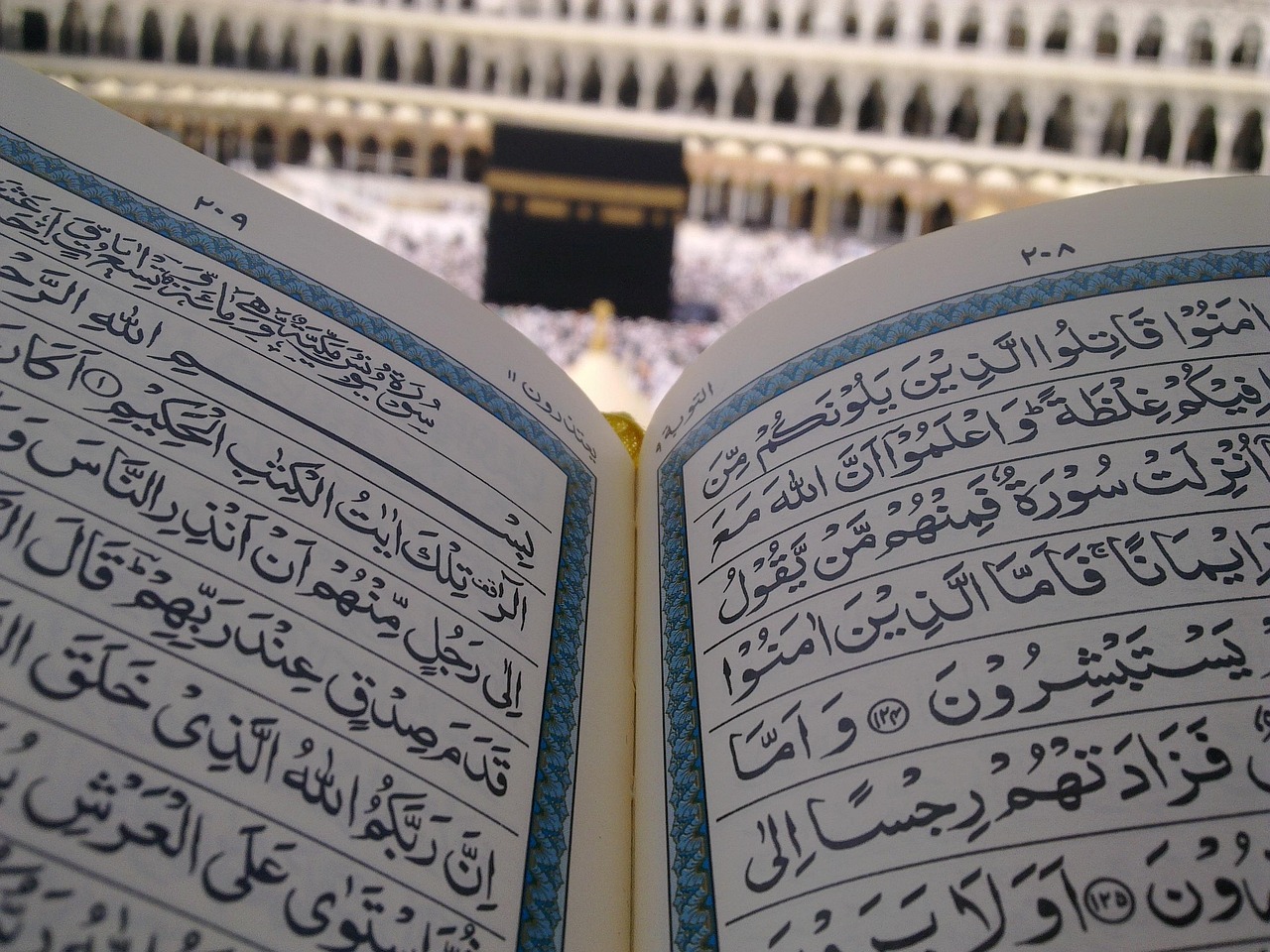
The Quran is the Holy Book of Allah. It contains wisdom and guidance for every human on this planet. It is regarded as the “way of living life.” Each page directs the Muslim to a better life, and every word enlightens. A typical mushaf (physical copy of the Quran) in Saudi Arabia contains a total of 604 pages. Yet, this number differs when there are translations involved.
For example, a simple Arabic Quran with translations may have more than 700 pages. Page count can also differ based on the font size. Some mushafs with a medium-sized font have a page count around 500, while others with a slightly larger font might have a page count closer to 750.
However, traditionally, the page count of a Quran doesn’t matter. Because when Muslims read it, they don’t measure their progress page by page; rather, the Quran is measured by terms such as “surah,” “juz,” or “ruku.”
The Structure Of The Quran
Most Quranic copies already come with a thin cloth bookmark attached to the mushaf. It is sewn into the spine of the book, and one can move it around to track their reading. However, Muslims use other terms to remember what verse they were on. Why? Because when the whole book is written in one language, with the same font size and complete uniformity between the entire text, it can get a little difficult to identify what one last read. These terms are printed in the Quran and serve as markers without the need for additional equipment.
Juz / Parah
The whole Quran is divided into 30 parts, each called a Juz or Parah. Both of these terms translate to the English word “part.” This is one of the most prominent indicators in the Quran and is the term most commonly used to track their reading. Each Juz is roughly around 20-22 pages long. Each mushaf has special markers that indicate when a Juz begins or ends.
This style is the most preferred for planning the reading because it allows for clear division without additional calculation. For example, if one wants to finish a whole Quran in one month, they just have to read 1 Juz per day.
Salasah
“Salasah” is an Arabic word meaning “three.” Each juz of the Quran is divided into four parts, and salasah is an identifier for three of those parts. Basically, it means that when the salasah symbol appears, ¾ of the Quran has been read, which can total 16-17 pages. This symbol is usually printed on the left or right side of the margin and appears to be beside a waqf (the circle symbol after a verse is completed).
Nisf / Hizb
A nisf or hizb is the half of a Juz. There are, in total, 60 hizb in the Quran, each containing a total of 18 pages. Just like salasah, this symbol is also printed on the margin next to the waqf. It is helpful when one wants to finish half of the juz in one sitting, and it makes it easier to break down the reading into manageable chunks.
Ar-Riba
“Ar-Riba” is also an Arabic word and means the number four. Not to be confused with the word “riba,” which means interest. Since most Juz include 20-22 pages, each ar-riba contains 4-5 pages. This word marks the completion of reading ¼ of the Quran, and, like “salasiah” and “nisf,” it is printed in the margin.
Ruku
The word “Ruku” is used in Arabic and, in the context of the Quran, roughly translates to “paragraph.” It denotes a group of verses with the same theme. There are 558 rukus in the Quran, and each contains about 10-12 verses. For example, a group of verses discussing the rights of orphans might be grouped together because of their shared nature. Ruku is the most common way Muslims read the Quran. Many have a habit of reading one ruku each day, as it breaks the task of reading the Quran into manageable chunks, making it seem less daunting.
It is also one of the most common methods used by hifz teachers, where each student moves ruku by ruku towards memorizing the whole Quran. This symbol is the same as the others and appears in the margins of the pages.